How I use AI
I use AI as a core part of my workflow. Not in the way most people think. I don't type a prompt and publish whatever comes back. I use Claude with Daniel Miessler's PAI (Personal AI Infrastructure) system, which is a structured, algorithm-driven framework that orchestrates research, verification, and iterative refinement. It's more like a workshop than a chatbot.
This page exists because I believe in transparency. If you're reading something I wrote, you deserve to know how it was made.
I recently came across a quote on fz42.net, adapted from Derek Sivers: "When you sign up to run a marathon, you don't want a taxi to take you to the finish line." That stuck with me. It captures exactly how I think about the relationship between AI and my writing.
How I write
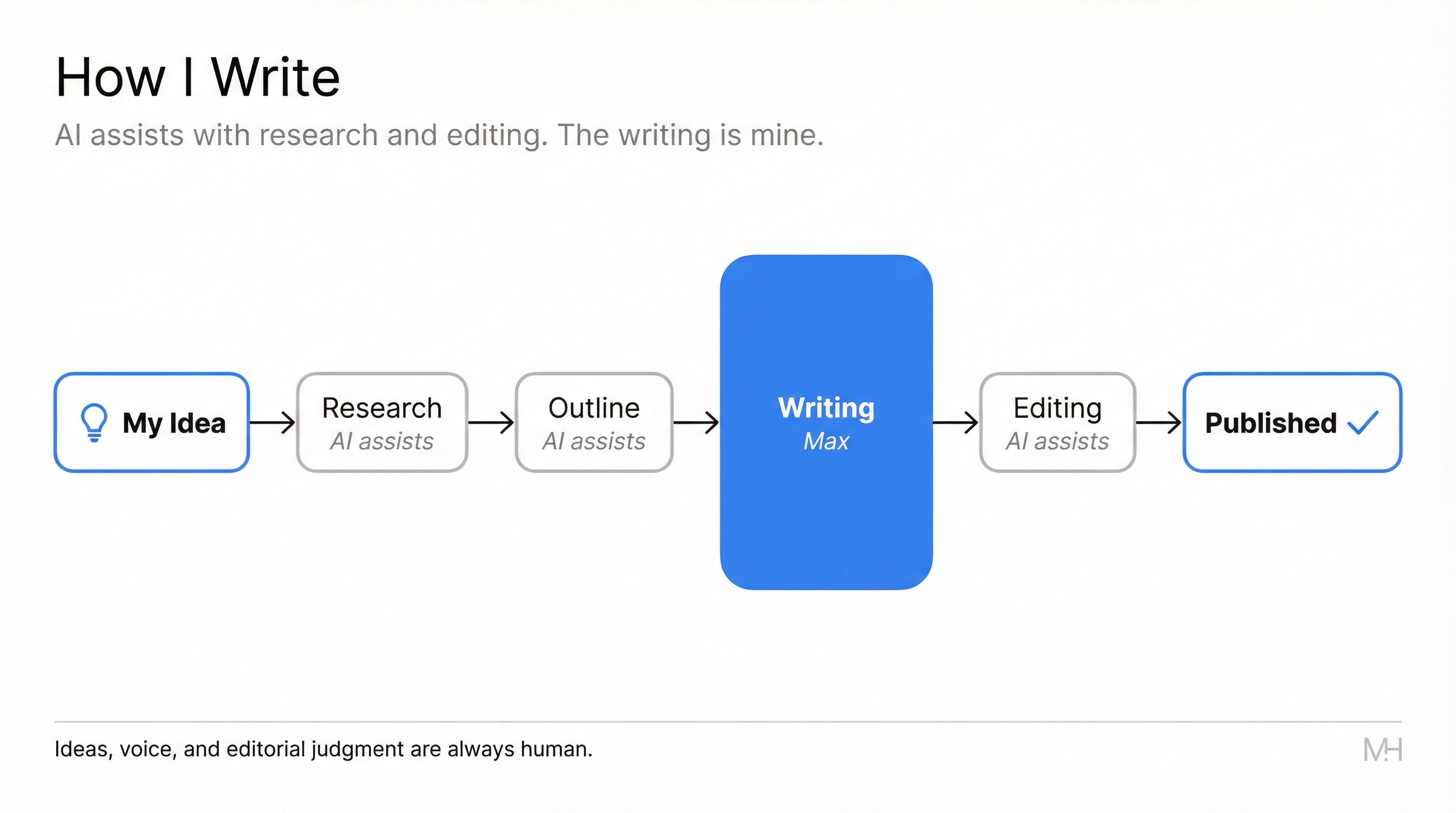
I write the content myself. I want to be clear: all the ideas, thoughts, and stories are mine. They are experiences I've lived, things I'm thinking about, and things I'm learning. AI helps me with research synthesis, brainstorming outlines, grammar and style refinement, and fact-checking, although I verify everything myself.
AI does not write my paragraphs, generate my opinions, or create my voice. When I write, I'm running the miles myself.
I don't publish AI-generated text as my own writing. Every sentence on this site was written or substantially rewritten by me. If AI ever contributes meaningfully to a piece beyond research and editing, I'll note it.
 Generated using the PAI Art skill
How I build
Building this website is a different story. I chose the tech stack I wanted (Next.js, Tailwind, TypeScript, MDX) after doing my own research. I designed the layout, made every content decision, and reviewed the code. But AI wrote most of it.
The marathon metaphor doesn't apply to infrastructure the same way it applies to writing. I think of it more like this: I designed the house, AI helped me build it, and I checked every wall. Code is infrastructure. Writing is craft. I intentionally treat those relationships differently.
The tools
When I say "AI-assisted," I don't mean I opened ChatGPT and asked it a question. My setup is more involved than that.
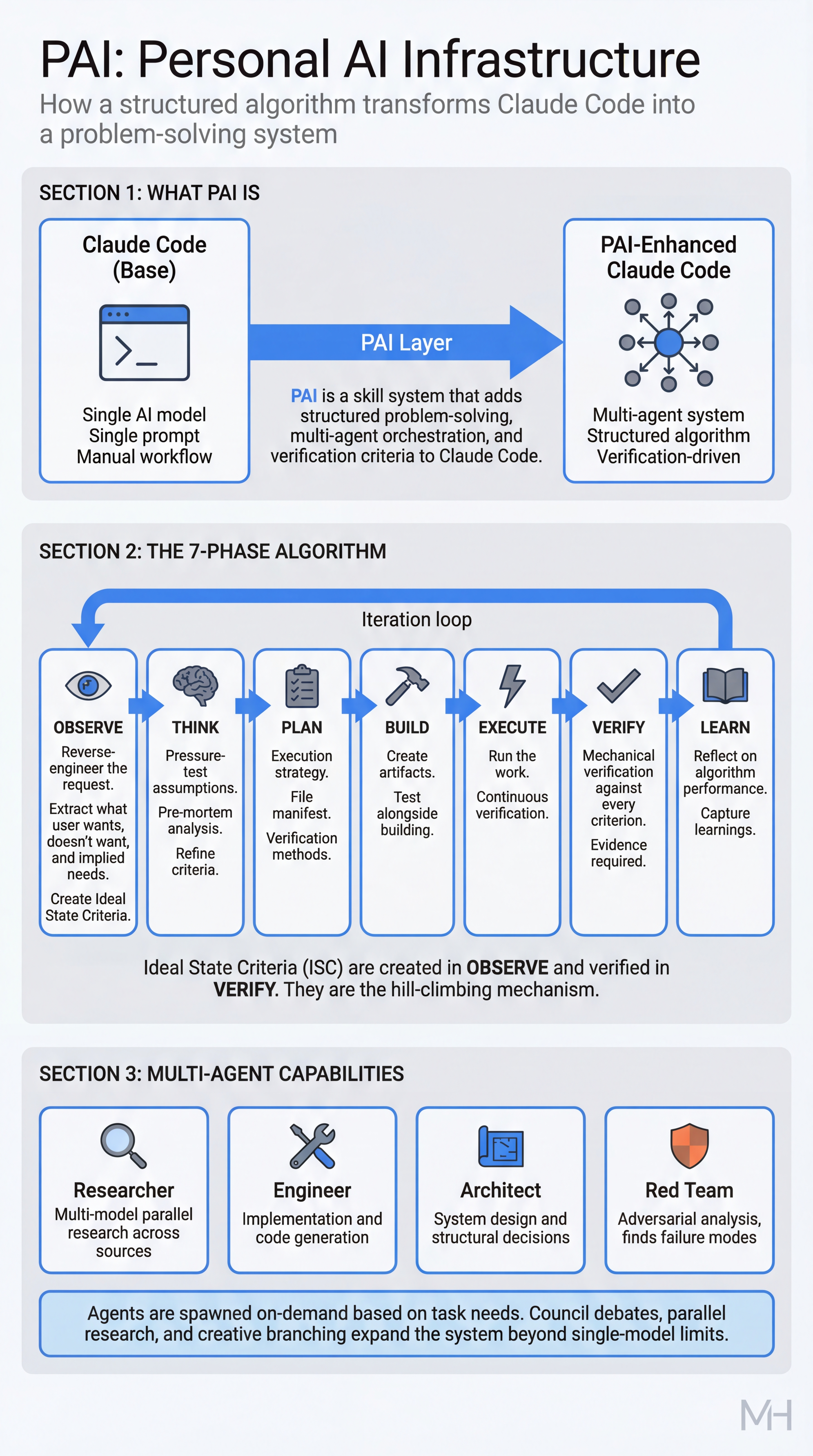
My primary tool is Claude by Anthropic. On top of Claude, I run PAI, Daniel Miessler's Personal AI Infrastructure. PAI is an algorithm-driven framework for structured problem-solving. Think of it as a workshop with specialized stations, not just one tool.
Here's what that means in practice:
- A 7-phase algorithm. Every task goes through Observe, Think, Plan, Build, Execute, Verify, and Learn. It's a structured loop, not a single prompt.
- Specialized agents. PAI can spin up researchers, engineers, architects, and even adversarial "red team" agents that try to poke holes in ideas. When I was researching AI transparency frameworks for this very page, I had parallel research agents pulling from multiple sources simultaneously.
- Verification built in. Every task produces specific criteria that get checked before anything is considered done. It's not "AI said it, so it must be right." It's "AI produced it, now let's verify it."
For non-technical readers: imagine having a team of specialists you can call on, each with a different expertise, who work through a structured process and check each other's work. That's closer to what this is than "I asked a chatbot."
 Generated using the PAI Art skill
The scale
I use Daniel Miessler's AI Influence Level (AIL) framework to think about where my content falls. It's a 0-5 scale:
- AIL 0 — Fully human. No AI involved at all.
- AIL 1 — Human-created with minor AI assistance. Grammar checks, light editing.
- AIL 2 — Human-created with significant AI augmentation. AI helped with research, restructuring, or substantial editing.
- AIL 3 — AI-created from human structure. You provided the detailed outline, AI wrote it.
- AIL 4 — AI-created from a basic idea. Minimal human input beyond the initial concept.
- AIL 5 — AI-created with little human involvement. Automated generation.
Most of my writing falls at AIL 1-2. I write it, AI helps me refine it. The website's code is closer to AIL 3. I provided the architecture and design decisions, AI executed them, and I reviewed everything.
As this site grows, I plan to add per-post AIL ratings so you can see exactly where each piece falls.
Why this matters
Research from Trusting News shows something interesting: 93.8% of people want AI use disclosed, but 42% trust individual pieces less once they see the disclosure. That's a real tension. Transparency costs you something in the short term.
I'm doing this anyway. Not because regulations are coming, though the EU AI Act takes effect in August 2026. I'd rather be honest about how I work than pretend AI isn't part of the process. Most people using AI aren't telling you. I'd rather be the kind of person who does.
This page will evolve as my tools and process change. If you have questions about how any specific piece on this site was made, reach out.
Last updated: February 2026